
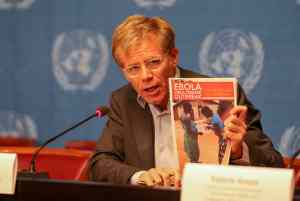
Mr. Bruce Aylward,Assistant Director-General for Polio, Emergencies and Country Collaboration WHO, during a press conference at the UN in Geneva concerning Ebola.
spreading is increasing.
Indeed, initial analysis indicates that the virus may be approaching
an exponential growth rate, and could be doubling approximately
every three weeks. There are well-founded concerns that the
outbreak could kill thousands more before it can be brought
under control. Such is the extent of uncertainty around the
evolution of the outbreak, that estimates of total impact
vary amongst the world’s most prominent infectious disease
institutions. To date, over 2,400 people have died from ebola.
The Governments of the affected countries have been responding
to the outbreak since it first emerged in March 2015. A number
of external issues such as difficulty in accessing affected countries
and communities; internal dynamics (low capacity of national
health systems and the unavailability of the requisite medical
personnel and goods on a scale adequate to prevent, trace
and treat the disease) and epidemiological reasons limit these
Governments’ capacity.
To respond to both the health and non-health aspects of the
crisis the World Health Organization has declared a Public
Health Emergency of International Concern (PHEIC), and the UN
Secretary General has activated the United Nations Operations
and Crisis Centre, appointing senior staff members to lead the
UN’s collective response to the crisis.
STRATEGIC OBJECTIVES
The overview of requirements covers primarily Guinea, Liberia and Sierra Leone, the three countries with
intense transmission of the virus. The overview also provides information on countries with localized
transmission of the virus, such as Senegal and Nigeria, or at risk of Ebola Virus Disease (EVD) transmission.
Building upon the WHO Ebola Roadmap and the activities and plans of all UN entities responding to the
ebola crisis, this overview describes the collective requiremen