 Ban Ki-moon was charming—in his own way. Charisma was not his strength. But some remember him as an « amiable » former UN Secretary-General who « got the job done. » Others disagree.
Whether the next UN chief, whose term begins 1 January 2027, can « get the job done » is today’s unsettled puzzle. The bigger questions: what future multilateral diplomacy could look like, and which job the next chief should « get done » first.
« I don’t envy you, » Ban told candidates for the top UN job on South Korea’s Jeju Island, dubbed the Island of Peace, at this year’s event, « Reimagining Multilateralism: A Dialogue with UN Secretary-General Candidates. »
Candidates must now compete on public stages. But the winner will inherit a UN in crisis—with its finances strained, its staff demoralized, its authority challenged and its credibility questioned.
Ban then contradicted himself. He would, in fact, envy the new chief, who will work side by side « the most dedicated people on earth, UN staff » and be “supported by diplomats, business leaders and civil society. »
The winner, Ban said, will have « the chance to write an epic chapter » of UN history and be “the true architect of the global agenda.”
It could be the race of the century—for UN fans.
But critics say the UN is fading. The 10th secretary-general, they argue, can do little amid sharp geopolitical divides in the multipolar and multicivilizational world.
The UN, some say, shows fatal symptoms like those of the League of Nations, which dissolved in 1946 and transferred its Geneva compound—with peacocks in its garden—to the new UN.
« The League of Nations was killed by the Second World War, » said current UN Secretary-General António Guterres. The post-war Security Council « played positive role, » he said, in avoiding « a war among superpowers, » a record that « will justify a reformed UN to remain at the center of a multilateral governance system. »
Skeptics ask: What if the UN is no longer at the center of global governance? Can the next chief devise a Plan B—or C—to lead the UN’s transition into a viable future?
The answer may lie in how these three puzzle pieces move.
First: who the next Secretary-General is.
Every UN chief has worked within the constraints of global powers’ dynamics and the limits of the office —a veto-bound Council, no army and no finances of its own. What shapes the outcome, some experts say, is the temperament, leadership style and crisis instincts each brings to the job.
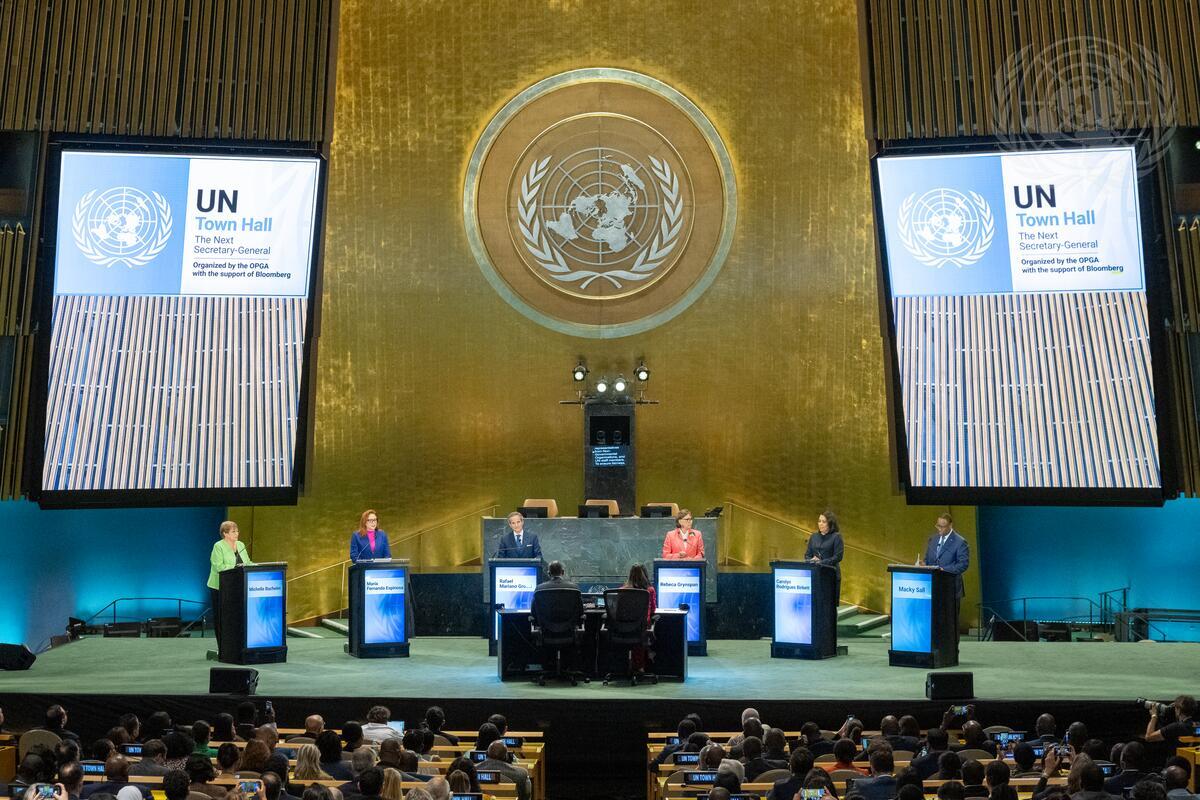
The race, which began last November, featured UNGA interactive dialogues in New York and public forums in Geneva, Jeju, London and Montevideo.
After the 81st UNGA September high-level week, seven candidates remained—four women and three men: Ivonne A-Baki of Ecuador; Carolyn Rodrigues-Birkett, Guyana’s former foreign minister; María Fernanda Espinosa, Ecuador’s former UNGA president; Rebeca Grynspan, Costa Rica’s former vice president and UN trade head; Rafael Grossi, Argentine diplomat and UN nuclear agency head; Macky Sall, former Senegalese president; and Olara Otunnu, a former Ugandan UN diplomat who introduced the straw ballot in 1981.
All candidates know the UN’s two realities: public theater and hard-nosed negotiations behind the scenes.
The Council decides who wins. The winner needs nine of 15 votes and no veto from the five permanent members (P5): China, France, Russia, the UK and the US.
Initial ballots are identical. Later, color-coded ballots separate P5 votes from the rest and show who faces a veto. The Council then sends one name to the UNGA for approval.
In the fifth identical ballot on 7 October, Grynspan led with nine « encourage, » six « discourage » and zero « no opinion » votes. Grossi had six, seven and two; Rodrigues-Birkett five, nine and one.
The Council, as in past races, is in deadlock along geopolitical lines, with the P5 blocking the front-runners, at least in the early rounds, until consensus emerges or deals are struck.
If not, the dark-horse scenario returns. A from-nowhere candidate or « a safe candidate, » agreeable to all, could emerge. The logic recalls 1981, when deadlock produced Javier Pérez de Cuéllar as « everyone’s last choice. »
It is Latin America’s « turn » for the post, a practice born of the 1981 deadlock and acknowledged by UNGA in 1997. But it’s not law.
An open secret: for decades, P5 members have demanded senior UN posts for their nationals in exchange for backing a secretary-general.
France blocked Kofi Annan’s appointment then withdrew; Annan named a French national to head peacekeeping. Ban appointed an American to head political affairs, three Britons to head humanitarian affairs and a Chinese to head economic and social affairs. Guterres created a counter-terrorism office headed by a Russian. These posts remain in P5 hands.
Civil society wants more transparency and less « backdoor dealing. » An NGO-backed campaign, 1 for 8 Billion, wants the first woman secretary-general in the UN’s history.
The 2026 candidates run on similar platforms: reforming the UN, fixing communication and doing less but better on peace, development and human rights. They differ on approach.
As the Council lacks consensus, new names, from the Middle East to Central Asia, have floated. In 1996, Annan emerged as a candidate only days before his selection.
Second: how multilateral diplomacy will evolve.
Experts differ. But some argue multilateral diplomacy—cooperation among three or more political entities—has followed visible cycles over centuries.
Some foresee the Western hegemonic cycle, or Mediterranean pattern, dating from the Bronze Age collapse roughly 3,200 years ago: a dominant power rises and falls; fragmentation or multipolarity follows; then a new power emerges.
Others, like historians Amitav Acharya and Manjeet Pardesi, point to the Indian Ocean’s 1st–15th century « multiplex » order, decentralized and without a hegemon, where networks of polities, merchants and religious actors shared responsibilities, rules and norms. Critics doubt it applies now.
Current trends show regions rising, Council reform stalled and power shifting to middle powers, civil society and small states of the Global South.
Cooperation will grow through fragmented groupings and issue-specific « coalitions of the willing.”
Yet the UN, its defenders say, remains the sole universal body and will not « die a slow death » but must « be reshaped out of its post-1945 configuration » – beyond an austerity exercise.
The next secretary-general « could matter historically, » analysts say. She or he can help manage the transition to a stable multipolar order—or become irrelevant as major powers run the order without the UN.
Third: what the next UN chief should focus on first.
The first task, insiders say, is to question whether what she or he believes to be right is wrong. Only critical « what if » questions reveal the true context and the right priorities.
The next UN chief, UN veterans say, must be a « global citizen » who overcomes personal biases, challenges his or her assumptions and rallies cross-civilizational support to deliver –despite UN structural constraints.
The top UN diplomat’s ability to empathize with competing worldviews and build trust across power centers through pragmatic coalition-building can ensure fierce competition does not foreclose cooperation.
His or her first priority, experts say, is to lay out contingency plans for the UN’s place in the « fragmented multilateral order. »
Personality and posture as an impartial and pragmatic broker, UN watchers think, is a must for gaining respectability and trust – and a seat among powers and blocs.
The second priority is to deliver on what the UN chief can control. Communication cuts across all responsibilities. And it is what he or she can control.
The UN’s weakest link, candidates and observers say, is failure to communicate beyond preaching to the choir.
The new UN chief, they say, must overhaul the UN’s outdated communication ecology for the digital age and public diplomacy, be visible and communicate with governments, peoples and leaders – particularly those who question « UN values. »
One cannot trust what one cannot see, diplomats say. Megaphoning ideals from the New York-based ivory tower cannot restore trust.
The third priority is to identify specific actions that show the UN can deliver on peace, development and human dignity.
The first quick win, pursued with strategic patience, will set the tone for the office. « Quiet diplomacy, » observers say, is not silent diplomacy.
The UN’s retreat to humanitarian responses and convening power is no strategy, critics say. This risks eroding its role as a trusted broker in preventing war, a core function of the UN chief.
Every secretary-general has had bright moments and dark hours.
Annan reached the UN’s post-Cold War peak with peace interventions, but the 2003 Iraq invasion « doomed » UN collective security. Ban rallied the world behind climate action and the Sustainable Development Goals, but Syria split the Council.
Guterres put AI on the global agenda, but Gaza still haunts while Iran, Sudan, Ukraine and “forgotten » wars persist.
Being UN secretary-general is one of the most impossible jobs.
Ban’s warning to the next secretary-general: « You may soon be frustrated from day two. Day one, you will be very happy. Day two, be prepared for that. »
With awkward but arguably endearing humor, he said « secretary-general » can stand for « scapegoat »—neither « president of the world » nor « secular pope. »
With pride, prejudice and personality, each UN chief enters and leaves one of the world’s highest public service offices.
The next UN chief can choose to « write an epic chapter » in UN history or be merely a supporting actor in global governance for a decade or less—a blink in the centuries of multilateral diplomacy across civilizations.
Personality, courage and « clarity of vision » do not decide whether a secretary-general succeeds. They decide whether failure is existential for the UN.
———————–
Suchada Kulawat is an analyst who served with Thailand’s Foreign Ministry, the UNDP’s Bangkok regional office, Thailand’s Permanent Mission to the UN, and with the UN at New York Headquarters and in UN peace missions in Africa, Asia-Pacific and Eur